About this training
This manual integrates structured forklift exercises with autism-specific adaptations. The program is a flatscreen simulation to reduce sensory load and maximize predictability. Beyond the core exercises, the manual offers notes on how simulator-based skills can be transferred into real-world operations, highlighting safety as a central concern during this transition. It also outlines approaches for assessment, helping trainers monitor progress and ensure that learners are ready for practical application.
Is it good for me?
Requirements
Across the European Union, forklift operators must complete a recognized training course covering theory and practice, pass a final assessment, and be formally authorised by their employer before operating a forklift. Requirements are based on EU occupational safety directives (Directive 2009/104/EC, Directive 89/391/EEC) and national regulations implementing these rules.
- Minimum age: 18 years (with limited exceptions for supervised vocational trainees).
- Medical fitness: Occupational health checks (vision, hearing, balance, reaction) are mandatory.
- Certification: Training and examination in both theory and practice are required. Certificates must be recognised nationally or EU-wide.
- Employer authorisation: A certificate alone is not enough — operators must be specifically authorised by their employer for the equipment and workplace conditions.
- Reasonable accommodation: Under EU equal treatment law, autism or disability is not a barrier; training must include adaptations such as visual instruction, reduced sensory load, and supportive communication.
EU Directives 2009/104/EC and 89/391/EEC, ISO 3691-1, and national forklift training standards.
Trainer Guidelines
Plan, deliver, and adapt sessions to learner needs. Keep it visual, short, and measurable.
- Setup: Flatscreen with additonal helmet mounted movement sensors. Sound should be adjusted.
- Instruction: Literal, visual steps + demos; ≤10-minute tasks; scheduled 5-minute breaks.
- Support: Clear start/end points; laminated pictograms; monitor sensory load; specific praise.
- Assessment: Observable criteria per exercise (e.g., “zero collisions”, “≤2 prompts”), log progress, adjust pacing/difficulty.
Do’s & Don’ts
| Do | Don’t |
|---|---|
| Use visual instructions and quick demos. | Overload with long verbal explanations. |
| Keep sessions short with proactive breaks. | Run long, fatiguing blocks without rest. |
| Define simple, measurable criteria. | Rely on vague impressions of progress. |
| Reinforce safe effort with specific praise. | Only point out errors or be generic. |
| Adapt to the learner’s profile. | Force a rigid, one-size-fits-all sequence. |
Curriculum (Modules 1–4)
Click a module for a one-screen summary. Open to see details and trainer tips.
Essence: Build visual vocabulary and pre-drive routines, then automate basic mast and fork operations.
- Control levers (I→III) — map levers to functions; repeat actions with timing.
- Free practice — obstacle-free driving to explore handling.
- Capacity plate — interpret load/capacity vs. mast reach/tilt.
- Outcome: correct naming; safe lever use; basic load chart literacy.
| Exercise | Purpose | Description | Trainer Notes |
|---|---|---|---|
| 1.1 Control levers I | Recognize controls | On-screen graphics highlight levers when actuated | Use visual overlay; let learner name each lever; go slow to reduce overload |
| 1.2 Control levers II | Map to functions | Execute specific lever sequences to feel machine response | Allow trial-and-error; encourage verbal labeling of actions |
| 1.3 Control levers III | Automate basics | Repeat sequences with timing between actions | Build automaticity; consistent neutral before direction change |
| 1.4 Free practice | Comfort & control | Drive in obstacle-free area | Coach posture, smooth inputs; reinforce zero-collision rule |
| 1.5 Interpreting capacity plate | Limits & stability | Graphical interpretation of load capacity vs. reach/tilt | Discuss stability triangle; relate to safe lifting envelope |
Essence: Develop route keeping, speed control, and precise steering in forward and reverse, with and without time gates.
- Slalom I–II — follow marked path through aisles; forward then reverse.
- Time‑gated slalom — maintain pace between checkpoints.
- Slalom III (donut) — full control; timed second segment.
- Slalom with load — unsecured load on forks; avoid shifts/drops.
- Parking — complete all marked parks correctly.
- Outcome: zero collisions; path compliance; load stability in motion.
| Exercise | Purpose | Description | Trainer Notes |
|---|---|---|---|
| 2.1 Slalom I | Path & steering | Drive marked path, pass checkpoints; no contacts | Forward first half, reverse second; continue even if contact (not a pass) |
| 2.2 Slalom I (with time gates) | Paced driving | Same path with time checks between gates | Be very patient with learners. Time gates are very strict, use your timewatch and the 2.1 exercise if necessary. |
| 2.3 Slalom II | Aisle complexity | Navigate shelves & winding passages without contact | Rehearse mirror use; plan turns early |
| 2.4 Slalom II (with time gates) | Consistency under time | Same as 2.3 with time checks | Stability before speed; Use 2.3 with your timewatch if necessary. |
| 2.5 Slalom III (donut) | Full control | Special donut-shaped course; timed second half | Coach path memory; no cone hits |
| 2.6 Slalom with load | Load stability | Unsecured load on forks around course | Keep mast slightly tilted back; low travel height |
| 2.7 Parking task | Finish discipline | Park correctly in all marked bays | Upnill and downhill rules; forks lowered or highered. Be very patient and do demonstrations first. |
Essence: Practice safe picking, transporting, racking, stacking, trailer loading/unloading, and route-based handling including special loads.
- Transport I–II — pick and move 3 loads; then stack and place pallets precisely.
- Racking — place on standard, cantilever, and drive‑in racks.
- Trailer work — unload and load in sequence (C1, C2, C3…).
- Simple → complex routes — apply learned skills on varied paths.
- Special freight — hazardous/sensitive loads; extra care.
- Free practice — open exploration of tasks.
- Outcome: accurate placement; stable stacks; zero collisions.
| Exercise | Purpose | Description | Trainer Notes |
|---|---|---|---|
| 3.1 Transport I | Pick & carry | Lift 3 loads from floor; carry through narrow area; set down at marked spots | Coach approach angle; forks at correct height; no contacts |
| 3.2 Transport II (stacking) | Stack precisely | Stack 3 loads; then place 3 pallets onto two vertically standing pallets | Use micro‑moves; check mast vertical; align before set-down |
| 3.3 Racking I | Rack diversity | Place loads on standard, cantilever, drive‑in racks | Scan clearances; mind rack type specifics |
| 3.4 Trailer loading/unloading | Confined work | Unload from trailer → area; then load from outside into trailer in logical order | Maintain sequence (C1, C2, C3…); low travel height; spotter if needed |
| 3.5 Route handling — simple | Apply basics | Follow a simple route while placing on racks | Plan turns; avoid over‑steer; maintain speed discipline |
| 3.6 Route handling — complex | Adaptability | Handle longer, tighter route using prior skills | Break task into segments; rest if overloaded |
| 3.7 Special freight | Risk awareness | Transport hazardous/sensitive load to target | Brief on hazards; smoother acceleration/braking |
| 3.8 Free practice | Confidence | Open practice with varied loads | Set mini‑goals; reinforce safe habits |
Essence: Maintain safe distances, speed discipline, and communication while people move around the vehicle.
- Few workers — low speed; follow instructions.
- Many workers — moderate speed; cooperation.
- Very many workers — higher traffic; unwavering safety.
- Outcome: zero contact; minimal obstruction; clear right‑of‑way behavior.
| Exercise | Purpose | Description | Trainer Notes |
|---|---|---|---|
| 4.1 With workers I | Low‑traffic safety | Move stock from outside → warehouse and place; few workers present | Drive slowly; obey directions; no contact or excessive blocking |
| 4.2 With workers II | Medium traffic | Same path with many workers present | Maintain moderate speed; anticipate crossings |
| 4.3 With workers III | High traffic | Same path with very many workers present | Strict right‑of‑way; horn and eye contact; still zero contact |
Pass rule: follow safety protocol; complete objectives without collisions; tighten tolerances after consecutive successes.
Disclaimer
This curriculum shows the full list of available modules. Trainers are free to choose, adapt, and sequence modules according to their professional judgement and the needs of each specific learner. The structure is a guide, not a prescription. Safety, learner well‑being, and individual readiness should always guide decisions.
Display & Hardware Configurations
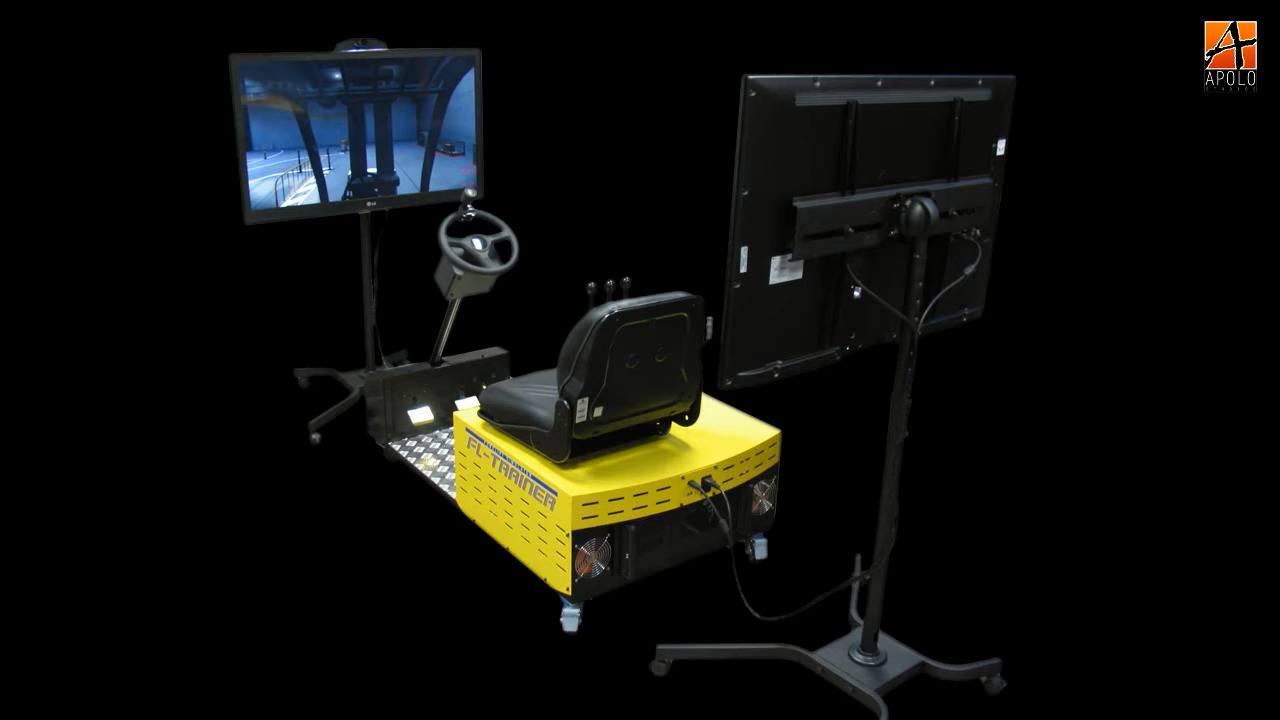
Apolo FL-Trainer setup: The simulator is built around a forklift-like chassis with an authentic driver’s seat, pedals, gears, buttons, and steering wheel. This design provides trainees with a highly realistic environment that mirrors workplace machinery.
- Dual monitors: One shows the forward field of vision, the other the rear view, reinforcing safe reversing and mirror habits.
- Head-tracking sensors: A helmet or headset equipped with motion sensors translates head movements into the simulation, shifting the camera view accordingly.
- Realistic controls: Pedals, mast levers, gears, buttons, and steering wheel replicate a real forklift and connect directly to the simulation software.
- Computer system: A powerful PC runs the simulation in real time for smooth graphics and responsive feedback.
Forklift Simulator – Minimal Hardware Setup
The essential equipment includes the simulator cabin with seat, pedals, levers, and steering wheel, dual front/rear monitors, a head-tracking helmet, and a high-performance PC with the forklift simulation software. This configuration delivers a highly immersive training experience without VR.
Grading Guideline
Dimensions: knowledge, procedures, control, safety, efficiency, teamwork.
| Dimension | Beginner (M1–2) | Intermediate (M3–4) | Advanced (M5–6) |
|---|---|---|---|
| Knowledge | Names parts with prompts; reads basic capacity plate | Explains lever functions; interprets capacity vs. reach/tilt | Anticipates risks; explains adjustments for special loads |
| Procedures | Follows steps with guidance | Independent pre‑shift checks & setup | Adapts procedures under pressure |
| Control | Basic moves; occasional corrections | Smooth driving; zero contacts | Fine precision; complex placements |
| Safety | Relies on instructor for safety | Consistent checks; no violations | Proactive, maintains safety under stress |
| Efficiency | Slow; needs prompts | Balanced pace; correct positioning | Fast & precise; meets timed goals |
| Teamwork | Responds to direct prompts | Communicates clearly around others | Fluent teamwork in complex tasks |
Progression: any safety violation = fail; advance after 3 safe runs; VR after sustained Intermediate/Advanced performance.
Reality Training — Transition to Heavy Machinery
Goal: create a safe, structured bridge from the simulator (flatscreen-first) to real forklift operation so that skills transfer reliably into the workplace. For autistic learners, the transition must balance technical certification requirements with supportive adaptations for communication, sensory needs, and predictability.
Learners should only transition to real forklifts once they demonstrate the following in simulation:
- Control: Precise use of levers, pedals, and steering wheel without collisions.
- Safety: Consistent observation of rules (e.g., stopping at intersections, mirror checks).
- Repeatability: Can reproduce tasks successfully across multiple sessions, with minimal prompts.
- Confidence: Learner shows comfort with routines and communicates readiness.
Recommended transfer threshold: Before entering a real forklift, learners should complete at least 5 consecutive successful simulator sessions demonstrating safe control, correct procedures, and independent task completion.
Trainer adaptation: For autistic learners, readiness must include comfort with sensory input (engine noise, vibration, lights) and understanding of social expectations in the workplace.
Before entering a real training yard, safety standards and EU workplace requirements must be in place:
- PPE: Hard hat, hi-vis vest, steel-toe boots, gloves, and hearing/eye protection as required.
- Environment: Predictable layout, clear markings, and minimized sensory overload (avoid flashing lights, excessive noise when possible).
- Communication: Use of consistent stop words/gestures and structured briefings. Trainers should avoid ambiguous language and provide step-by-step instructions.
- Documentation: Record attempts, errors, and improvements to build an audit trail for certification.
Recommended transfer threshold: Learners should successfully complete the simulator-based safety routine, including PPE preparation, pre-operation checks, and hazard identification, during 3 consecutive sessions before starting real forklift familiarisation.
Autism adaptation: Provide laminated visual PPE checklists, allow noise-cancelling hearing protection if safe, and agree on a personal “pause” signal the learner can use if overwhelmed.
-
Stage 1 — Familiarisation (truck off):
Sit in a real forklift with power off; practise posture, control identification, and mirror checks in a calm setting.
Recommended repetitions: 3 consecutive successful familiarisation sessions before activating the machine. -
Stage 2 — Engine on, micro-tasks:
Short straight moves with no load; coach one parameter at a time (e.g., steering only).
Recommended repetitions: 5 consecutive successful repetitions without safety corrections before progressing. -
Stage 3 — Basic manoeuvres:
Simple slalom and parking tasks in an enclosed yard, under supervision.
Recommended repetitions: 5 consecutive successful manoeuvre cycles with correct positioning and no collisions. -
Stage 4 — Load handling:
Introduce pallet lifts, short transfers, and simple stacking; narrow tolerances only after consistent success.
Recommended repetitions: 5–10 consecutive successful load-handling tasks depending on task complexity and workplace requirements. -
Stage 5 — Workplace integration:
Shadow a certified operator; complete small low-risk tasks; gradually increase complexity.
Recommended repetitions: Minimum 5 successful supervised workplace tasks before independent operation is considered.
Trainer adaptation: For autistic learners, transitions between stages should be announced in advance, with visual schedules and predictable routines.
- Certification alignment: Ensure assessments cover both simulator-based metrics (collision-free, timing, path accuracy) and real-world standards set by EU forklift operator certification.
- Debrief loop: Use video or screenshots to show the learner what went well and what to improve. Keep feedback concrete and visual.
- Progress logging: Maintain clear records of completed modules, PPE compliance, and safety checks for formal sign-off.
- Support strategies: Allow extra time for exams, provide instructions in both text and visual form, and offer structured breaks to reduce stress.
Recommended final readiness criterion: Before independent real forklift operation, learners should demonstrate 5 consecutive successful complete work cycles combining inspection, driving, manoeuvring, load handling, parking, and shutdown procedures without safety-critical errors.
Autism adaptation: Success criteria should be transparent (e.g., “no collisions in 3 consecutive runs”), reducing uncertainty and anxiety about hidden expectations.
Pass rule (reality): Learners progress only after demonstrating safe behaviour, repeatability, and comfort. Any safety violation = immediate stop and reset. For autistic trainees, sensory and communication needs are considered part of readiness, not barriers to certification.
Enhancements & Options — Apolo FL-Trainer
The FL-Trainer can be upgraded with additional scenarios, such as hazardous material handling, seasonal surface conditions, and narrow-aisle operations. These provide a closer match to workplace realities.
Autism adaptation: Scenarios can be repeated at the same difficulty to build confidence before advancing.
While the base system focuses on task execution, the trainer’s PC can be extended with software that records attempts, time taken, and collision data. Exported logs or templates can be used to create progress charts and learner profiles.
Autism adaptation: Visual progress charts (icons, bars) are especially effective in showing improvement transparently and reducing anxiety about hidden expectations. Different angle replay and pause reduce stress and allow step-by-step coaching
Settings for control sensitivity and sound levels make the simulator more accessible. A noise-reduced training mode allows learners to focus visually.
Autism adaptation: Essential for reducing sensory barriers and ensuring learners succeed without overload.